
To reduce average handle time on broadband support calls, separate repeated clarification from internal delays and necessary testing. Each needs a different response: clearer questions can resolve ambiguous descriptions, process changes can shorten internal waits and model-specific guidance can keep troubleshooting on track.
For example, an advisor may spend several rounds asking which router light is flashing before establishing that the customer is describing a Wi-Fi extender. That is handling effort worth investigating. Waiting for a required line test serves a different purpose, even if both activities make the call longer.
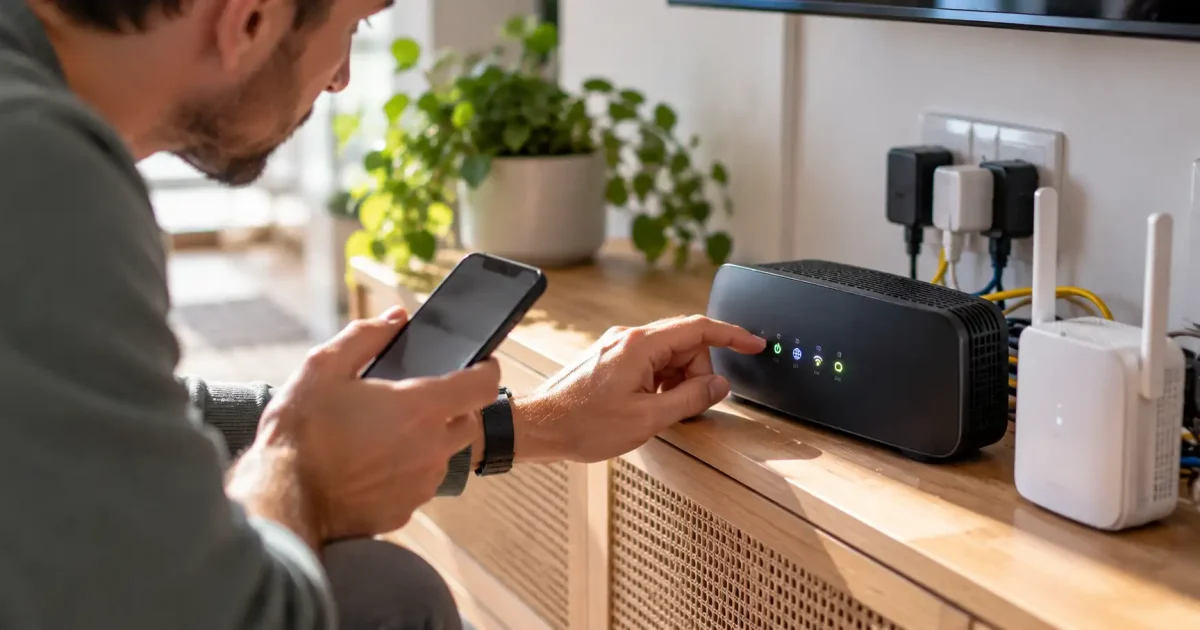
Seeing the equipment can help when a specific visible detail changes the next safe diagnostic action. The question is whether obtaining that view removes more effort than it adds, while preserving the testing needed to establish whether internet access has returned.
Establish what your AHT number includes
For voice calls, calculate average handle time as:
AHT = (total talk time + total hold time + total after-call work) ÷ handled calls
Use the same reporting period and call population for every component. Talk time covers the conversation with the customer, hold time covers periods when the call is on hold and after-call work covers the associated wrap-up tasks after the call ends.
In a hypothetical example, 100 handled router-support calls contain 600 talk minutes, 150 hold minutes and 150 after-call-work minutes. That is 900 handling minutes divided by 100 calls: nine minutes AHT.
Pre-answer queue waiting is excluded. AHT also differs from elapsed resolution time, which may stretch across hours or days, and cumulative handling effort, which includes the work generated by subsequent contacts.
Check how your reporting platform treats transferred calls, consultation time and handled-call counts before comparing teams or periods. Keep that treatment consistent. If visual assistance runs alongside a voice call, do not add its full session duration to minutes already counted as talk or hold time. Record any advisor effort outside the voice reporting boundary separately.
There is no useful universal target for every router call. Compare like with like: initial setup, intermittent Wi-Fi complaints and loss-of-internet faults involve different work. Changes in escalation mix or outage volume can move the average without any improvement in the underlying workflow.
Find the work behind the minutes
Talk, hold and after-call-work totals show where time accumulates. They do not tell you why. A long conversation might contain repeated questions about cables, a necessary recovery interval or careful confirmation that the customer can get online.
Review a representative sample from one call reason. Follow each interaction through fault identification, troubleshooting, symptom verification and documentation. Use agreed observation tags to distinguish these activities:
| Work observed | What to investigate | Likely intervention |
| Repeatedly identifying devices, ports or lights | Which physical fact remains unresolved? | Clearer questions, model-specific instructions or a targeted view |
| Waiting for account checks, line diagnostics or escalation | Is the delay necessary or caused by an internal workflow? | System access, process changes or escalation ownership |
| Waiting for equipment to recover after an approved test | Is the correct model-specific interval being followed? | Better test guidance, not an arbitrary time cut |
| Repeating instructions the customer cannot follow | Is the obstacle language, accessibility or an unclear diagram? | Adapted explanation or shared review of the relevant instructions |
| Rebuilding findings during documentation | Which facts and test results were not captured clearly? | A concise diagnostic note structure |
Clarification time is an analytical subset of handling time, not an extra amount to add to AHT. Reviewers should tag observable behavior, such as an advisor re-asking which device is flashing because its identity remains uncertain.
Also distinguish that repetition from a useful confirmation after a change. Asking whether an indicator has changed following a test is evidence gathering, not automatically rework.
Follow one fault from unclear equipment to a meaningful test
Consider a hypothetical customer whose laptop has lost internet access. The advisor first checks service status, account information and available diagnostics. A known outage should not trigger unnecessary troubleshooting inside the home. Seeing equipment cannot establish provider-side outage or line conditions.
The available service information supports investigating the home connection, but three descriptions remain unclear: which device the customer means, where a cable is connected and which indicator is flashing.
First, identify the device. The customer calls every networking box “the router.” A clear question about its location and model may settle this. If it does not, a consented equipment view could distinguish the gateway from a separate Wi-Fi node. That changes which device’s instructions and recovery procedure the advisor should use, avoiding another round of questions about the wrong box.
Next, establish the cable position. “It is plugged into the back” does not identify a port. A focused view can show the port label and cable placement. The advisor compares that arrangement with the identified model’s installation instructions. If it differs, the next action may be a manufacturer-approved connection correction rather than another restart. The view establishes the physical fact; it does not prove the cable or service is working.
Then, interpret the indicator on that model. “The blue light is blinking” is not a diagnosis. The advisor needs the indicator’s label, its state and the correct model documentation. Those details determine whether the next approved step is to allow a startup interval to finish or follow a fault-specific test. Color alone is not enough.
Keep factory resets out of the default workflow. They can introduce configuration and reconnection work. Never direct a customer to handle damaged electrical equipment.
Finally, return to the original symptom. The customer checks internet access on the affected laptop, rather than relying on a reassuring router light or a Wi-Fi connection symbol. Wi-Fi association is not proof of internet service. If a phone is used for verification, make sure cellular data is not silently supplying the connection.
Record the model, observed connection, indicator state, tests performed and verification result. If access remains unavailable, route the unresolved fault with those findings so the next advisor can continue without reconstructing the facts from the beginning.
Make the view easier than the uncertainty it replaces
Use the least burdensome way to establish the missing fact. Existing account records may identify the supplied router. A precise verbal question may establish the port label. A model-specific instruction may explain where to find an indicator. A still image may be enough for a label or cable position, while a live view may help when the unresolved fact is a changing light pattern.
Suppose the customer can now show the equipment clearly, but the troubleshooting document uses a diagram they cannot relate to the device. The advisor and customer can review the appropriate document together, matching the pictured indicator and port to what they have already identified. The customer then performs the agreed test. Shared review addresses the difficulty interpreting the instruction; omit it if the advisor can explain the test clearly. If the test restores access, stop adding tools.
Before offering remote visual assistance, the advisor should be able to finish this sentence: “If I can see this detail, I can choose between these next actions.” If no diagnostic decision depends on the answer, keep the camera out of the call.
The customer’s failed broadband connection matters. Assistance may require usable mobile connectivity and may consume mobile data. Explain the purpose, obtain consent and establish whether the customer can participate before spending time launching it. If they decline, cannot use a camera or lack connectivity, retain a verbal route and use the available diagnostic or escalation process.
Ask only for the relevant equipment detail. Keep passwords, Wi-Fi credentials and unrelated household information out of view. If the model label also contains credentials, ask the customer to cover them or read the model aloud.
Set a practical fallback point for failed launch attempts. Repeatedly trying to start assistance can recreate the very clarification burden the workflow is supposed to remove.
Pilot for less work across the issue
Start with a narrow eligible group, such as loss-of-internet calls where device identity or cable placement remains unclear after normal verbal clarification. Compare similar cases using the existing approach and the revised workflow. Random assignment is preferable where practical; otherwise match the call reason, equipment mix, agent experience and escalation profile, and account for major outages.
Set the baseline period and follow-up window before the trial. For example, use four weeks of baseline calls and a seven-day same-issue repeat-contact window. These are illustrative design choices, not industry standards. Let every issue complete its follow-up window before reporting results.
Define how the same issue will be linked across phone, chat and other channels. A closed record or a lack of another phone call is not enough to establish resolution.
Track a compact set of measures:
- Clarification time: Time spent establishing the device, port or indicator facts, including the effort needed to obtain the view.
- Voice AHT and its components: Report total AHT and average talk time, hold time and after-call work separately, using the same call population, denominator and reporting rules as the baseline. This shows whether the workflow removes effort or shifts it between components.
- Assistance setup time: Time spent offering and establishing assistance, including unsuccessful attempts. Tag it within handling time rather than adding it again to AHT.
- Symptom-verification rate: The share of eligible issues with a documented internet-access test on the affected device after troubleshooting.
- First-contact resolution: For this pilot, confirmed recovery during the initial contact with no linked same-issue contact during the follow-up window. A transfer within that contact can qualify if recovery is confirmed, but retain all handling effort. Unresolved escalations do not qualify and unknown outcomes remain separate from confirmed successes.
- Same-issue repeat contacts: Linked contacts during the window, including those arriving through another channel.
- Cumulative handling minutes per initial issue: All initial and linked follow-up handling minutes divided by the number of initial issues, including unresolved ones.
For cumulative effort, count transferred handling segments consistently without duplicating the same recorded segment. Include separately measured assistance effort omitted from the voice report, but do not count concurrent voice and visual minutes twice for the same advisor.
Keep declined offers and failed launches in the assigned workflow group. Reporting only successful visual sessions would hide deployment friction. You can examine those sessions separately to understand the mechanism, but they are not the whole operational result.
A longer initial interaction may be worthwhile if it prevents enough later work. It may also add effort without changing the outcome. The pilot should distinguish those possibilities rather than assume that a clearer view produces savings.
Remove avoidable effort without cutting the test
Use the findings to change the part of the workflow that consumes avoidable time. If advisors are waiting on provider systems, fix that workflow. If they keep reconstructing the same equipment facts, expand the approach that demonstrably reduces clarification and downstream work, whether that is a simpler question, clearer instructions or selective visual assistance.
Protect necessary recovery intervals and the final internet-access test. If an AHT improvement disappears once repeat contacts are counted, the workflow has moved effort rather than removed it. For unresolved faults, leave the observed equipment details, completed tests and verification results the next advisor needs to continue.